Month-End Books for a Small Mine: Power, Fees, Coins
A mining operation has two meters worth reading, and only one of them is a number the pool shows you. At 222 TH/s the daily credit is 0.00009959 BTC, worth $8.43 gross and $8.10 after the listed 4% on the block-reward component. Thirty days of that pays for a lot of electricity, but not unlimited electricity, and the month-end subtraction is where that becomes visible.

Key takeaways
- Thirty days at 222 TH/s produce 0.00298773 BTC, or $252.90 gross at BTC $84,692.
- The listed 4% on the block-reward component removes $10.12, leaving $242.78 before power.
- A 3.4 kW load for 720 hours at $0.07 per kWh costs $171.36, leaving $71.42 for the month.
- Reconcile in BTC first and in dollars second, because the coin total is unaffected by price moves.
Two meters, one month
The pool meter counts shares and converts them into coins. The utility meter counts kilowatt-hours and converts them into a bill. Both run for the same month, and the only meaningful statement about the operation is the difference between them. Everything in between, from firmware choices to fan curves, exists to make that difference larger.
Most operators look at the first meter daily and the second one monthly, which is why the monthly figure is the one that surprises them. A change of a few degrees in the room, a dusty filter or a machine running at a lower clock for part of the month all show up in the second meter and barely register in the first.
Four lines that close the month
A useful ledger has four lines and no more: coins credited, the pool fee already deducted, power consumed, and the remainder. Adding detail beyond that usually obscures the comparison. If you want to track repairs or hosting separately, put them below the line rather than inside it, so the operating margin stays comparable from month to month.
| Line | Calculation | Amount |
|---|---|---|
| Gross credit | 30 × $8.43 | $252.90 |
| Listed fee, block reward | 4% of $252.90 | −$10.12 |
| Power | 3.4 kW × 720 h × $0.07 | −$171.36 |
| Operating remainder | $252.90 − $10.12 − $171.36 | $71.42 |
Four lines, one arithmetic check, and the month is closed. The remainder is what funds repairs, replacement and any growth; it is not profit in an accounting sense, because the hardware is depreciating while it runs. Treat it as the cash the operation generates before the machines are replaced.
Where the bill and the dashboard disagree
The two meters measure different things, so a perfect match is not the goal. The pool measures accepted shares, which stop when a machine stops submitting even if it is still drawing power. The utility measures consumption, which continues through every reboot, every stalled firmware update and every hour spent hashing on a pool connection that was not actually accepted.
That asymmetry explains the most common month-end puzzle: power up, coins flat. A worker whose password field changed, or whose connection moved to a dead port, keeps burning electricity while producing nothing. The gap between the meters is the only place this shows up if you are not watching the worker list.
Reconcile the coin total first
Dollars introduce a second variable, and mixing it into the reconciliation makes the arithmetic harder to audit. The coin total for a month at 222 TH/s should be very close to 0.00298773 BTC times the fraction of the month the machine was online. Check that against the payout history before converting anything.
Only then apply a price. The ViaBTC Crypto Mining account view lists each settlement, and the CSV or statement you keep should record the BTC amount rather than the dollar value at the time. A month later the price will have moved, and a ledger built on dollar receipts cannot be reconciled with a wallet balance.
Turning a month into a rate
Divide the remainder by the hashrate and you get a number per terahash per month, which is the figure to compare across periods. At 222 TH/s with the assumptions above, $71.42 a month is about $0.32 per terahash per month. If the next month comes in at $0.24, the cause is either a higher bill or fewer coins, and the four-line ledger tells you which within a minute.
That per-terahash rate also travels. When you consider adding machines, the new unit inherits the same coins per terahash but a possibly different power cost, because a different circuit or a different tariff may apply. Multiply the new unit's terahashes by the rate for the coins side and calculate its power separately; do not assume the blended rate holds.
What to do with the remainder
Three uses compete for it: repairs, replacement and withdrawal. Keeping the remainder in coins exposes it to price moves; converting it to currency removes that exposure and creates a taxable event in most jurisdictions. Neither choice is universally right, and the decision belongs with whoever keeps the books rather than with the mining software. What the ledger needs from you is a single clear line saying which of the three took the money.
What matters for the ledger is consistency. Pick a rule, apply it every month, and note it beside the numbers. An operation that converts half the remainder and holds half can still be compared month to month as long as the rule does not drift. An operation that changes the rule whenever the price moves cannot be compared with anything, including itself. Write the rule at the top of the sheet, and next January you will thank the version of you who did.
Worked example
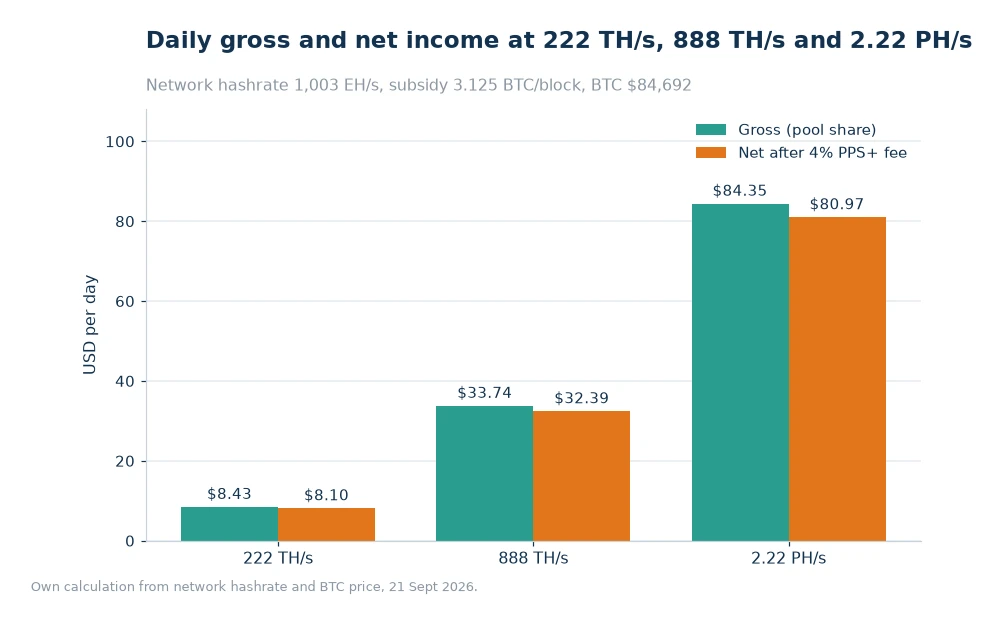
The chart's three points make the monthly arithmetic easy to extend, because each is a simple multiple of the last.
- Each terahash is credited 0.00000044865 BTC per day, which is 450 BTC split over 1.003 billion TH/s.
- At 222 TH/s: 222 × 0.00000044865 = 0.00009959 BTC a day, or $8.43 at $84,692.
- Net after the listed 4%: 8.43 × 0.96 = $8.10 a day.
- Thirty days: 30 × 0.00009959 = 0.00298773 BTC, $252.90 gross and $242.78 net.
- 888 TH/s, four machines: $33.74 gross and $32.39 net a day, $971.70 net for the month.
- 2.22 PH/s, ten machines: $84.35 gross and $80.97 net daily, $2,429.10 over 30 days.
Frequently asked questions
How much does a 222 TH/s machine earn in a 30-day month?
About 0.00298773 BTC at continuous uptime, which is $252.90 gross and $242.78 net at $84,692 before any power cost is applied.
Why is my power bill higher than the coins I earned?
At 3.4 kW and $0.07 per kWh the monthly bill is $171.36 against a net credit of $242.78, so a higher tariff or a larger load can easily invert the comparison.
Should the ledger record dollars or bitcoin?
Record bitcoin for the credit and dollars for the bill, then convert at a stated rate. Mixing the two in one column makes the month impossible to reconcile later.
Close the month, then change one thing
Four lines, one subtraction, a per-terahash rate and a note about what you did with the remainder. That is a complete set of books for a small operation, and it takes ten minutes a month. The value is not the paperwork; it is that a change in any one input becomes visible immediately rather than at the end of the year.
When you do find a gap, change one thing at a time. The Profit Calculator will show what the daily credit should be for a given hashrate and power cost, and the pool state page shows whether the network itself moved. If both are unchanged and the ledger is not, the answer is in the room with the machines.
Sources: the pool statistics and pricing pages at ViaBTC[1]. Inputs as of 21 Sept 2026: 1,003 EH/s network, 132.76 T difficulty, 3.125 BTC subsidy, 144 blocks daily, BTC $84,692. Published 24 Oct 2026; the 3.4 kW load and $0.07 tariff are assumptions.