Subscription Value per Hour of Use
Value per hour is the most honest way to judge any recurring leisure service, and it is also the figure almost nobody calculates. Hours are the denominator that matters, because they capture both how often you turn up and how long you stay. Two readers with identical monthly volume can differ by a factor of twelve in hours once pace is accounted for.

Key takeaways
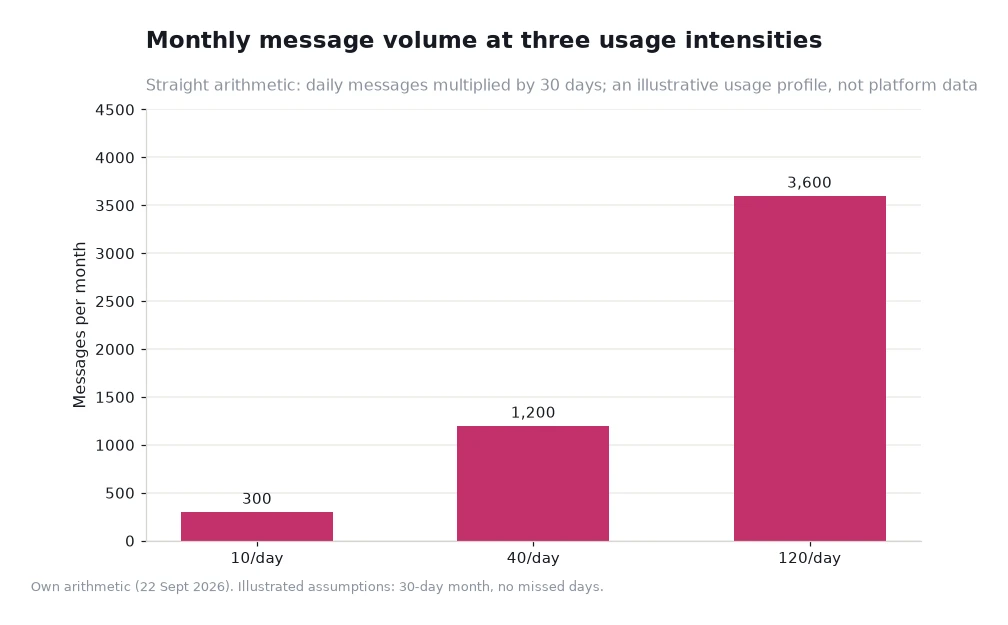
- Convert volume into hours before comparing anything: 300, 1,200 and 3,600 messages a month become about 75, 300 and 900 minutes at an illustrative 4 messages a minute.
- A flat access level spreads across hours, so the effective figure per hour falls as hours rise.
- Fifteen hours a month is thirty minutes a day, which is an ordinary leisure budget and worth spending deliberately.
- Recalculate quarterly, because the denominator moves with your habits rather than with the plan you chose.
Why the denominator decides the comparison
Monthly figures are easy to read and almost meaningless on their own, because a service used four hours a month and one used twenty are not the same proposition at the same amount. Dividing by hours converts both into a comparable number, and the number tells you which one you have actually been using.
It also exposes the thing people get wrong about flat access. A fixed access level does not become better or worse when your usage changes; the figure per hour does. Double the hours and you have halved the effective figure without changing anything you agreed to.
That is why the useful question is not which option to pick in the abstract but how many hours you will actually spend. Answer that first, and the comparison almost makes itself.
There is a second-order effect worth knowing about. Hours spent badly still count in the denominator. If a quarter of your sessions end early because the character was the wrong fit, the effective figure per hour is worse than the arithmetic suggests, since the same amount bought three meetings that went nowhere. Improving the fit of your sessions does not change the hours, and it does change what those hours were worth.
So the calculation has two inputs rather than one: hours on the bottom, and the share of those hours you would choose again on the top. Readers who track both usually find the second input is the one with room to improve.
Trial months are the exception worth planning for. A month you treat as an experiment will have an unusual hour count, so it should not be used as the denominator for a permanent decision. Note the trial separately, compare the normal months to each other, and treat the exceptional one as information about the ceiling rather than about the habit.
Measuring your own hours
Start from messages, because they are easier to remember than minutes. Using an illustrative typing pace of about four messages a minute, 300 messages a month works out at 75 minutes, 1,200 messages at 300 minutes, and 3,600 messages at 900 minutes. Those are 1.25 hours, 5 hours and 15 hours respectively, all on a 30-day month.
The same figures can be read as share of a day. Fifteen hours a month is half an hour a day; five hours a month is about ten minutes a day; an hour and a quarter a month is two and a half minutes a day. Framed that way, the decision about access level depends on which of those three habits describes you.
Then check the pace assumption against your own experience. Some readers type in short bursts and send four messages a minute; others write at length and send one. If your sessions feel slower, the same message total represents more hours and the per-hour figure is better, not worse, which is exactly the kind of correction a rough measurement produces.
| Daily messages | Messages a month | Minutes a month | Per day |
|---|---|---|---|
| 10 | 300 | About 75 | Two and a half minutes |
| 40 | 1,200 | About 300 | Ten minutes |
| 120 | 3,600 | About 900 | Thirty minutes |
| Slow typist | Same volume | More minutes per message | Higher value per hour |
| Burst reader | Same volume | Fewer minutes per message | Lower value per hour |
The fourth and fifth rows are the ones people skip, yet pace explains most of the variation between two readers with the same monthly total. A slower reader is not using less of the platform; they are getting more hours out of the same volume.
Worked example: the effective figure across three habits
Assume a flat access level and compare three readers across it. The light reader at 300 messages a month spends about 75 minutes; the moderate reader at 1,200 spends about 300 minutes; the heavy reader at 3,600 spends about 900 minutes. Because the amount is the same, the effective figure per hour is inversely proportional to those hours.
Index the light reader at 1. The moderate reader gets four times the hours from the same amount, so their effective figure per hour is one quarter. The heavy reader gets twelve times the hours, so their effective figure per hour is one twelfth - 900 divided by 75 is 12, and that single multiple is the entire value argument for a flat access level.
Put differently, the question of whether the access level is worth it reduces to whether you will spend closer to 1.25 hours or 15 hours a month. Most readers can answer that from two weeks of logging, and the answer is usually more stable than they expect.
What the per-hour figure is good for
It is good for one decision and one habit. The decision is whether a flat access level matches your usage; the habit is spending the hours you have deliberately rather than by default. A reader on fifteen hours a month who spreads them across ten characters is spending an hour and a half with each, which is not enough time to get past the first impression of most of them.
Choosing well is part of the value. The catalogue is large, so a shortlist built through character search concentrates your hours on characters that suit you, and the platform's description of porn ai chat, which it files under the heading Porn Chat AI, is the practical place to read how the format is meant to work before committing a month of it.
Recalculate the figure every three months. Habits move, the denominator moves with them, and the number you calculated in the spring is usually wrong by summer.
Frequently asked questions
Why measure in hours rather than sessions?
Because sessions vary in length. Two sessions of ninety minutes and nine of ten minutes are the same count and completely different amounts of use.
How accurate does the pace estimate need to be?
Not very. Being out by one message a minute changes the hours by around 25 percent, which is well inside the range where the decision stays the same.
What if my usage is seasonal?
Calculate the figure on a normal month rather than a peak one, and keep the peak in mind as the reason a flat access level can still make sense.
Divide by hours before deciding
Log two weeks, convert the messages into minutes, and write down the monthly hours. Then look at the number and ask how much of it you would have chosen deliberately. That one calculation does more for the decision than any list of features. Readers aged 18 or older are the intended audience for this article.
Sources: the feature wording and trending counters referenced above were read from Crushon on 22 Sept 2026. The four-messages-a-minute pace and the monthly totals derived from it are illustrative assumptions created for this piece, and no prices or plan names are quoted anywhere in it.[1]