A Closer Look at Building a Supplier Audit Checklist
A supplier audit checklist should help an assessor gather evidence against defined requirements, not simply record whether a factory has a polished presentation. Start with the decision, supplier site, and product risk. Use clear prompts for documents, observations, interviews, sample records, limitations, and corrective actions.
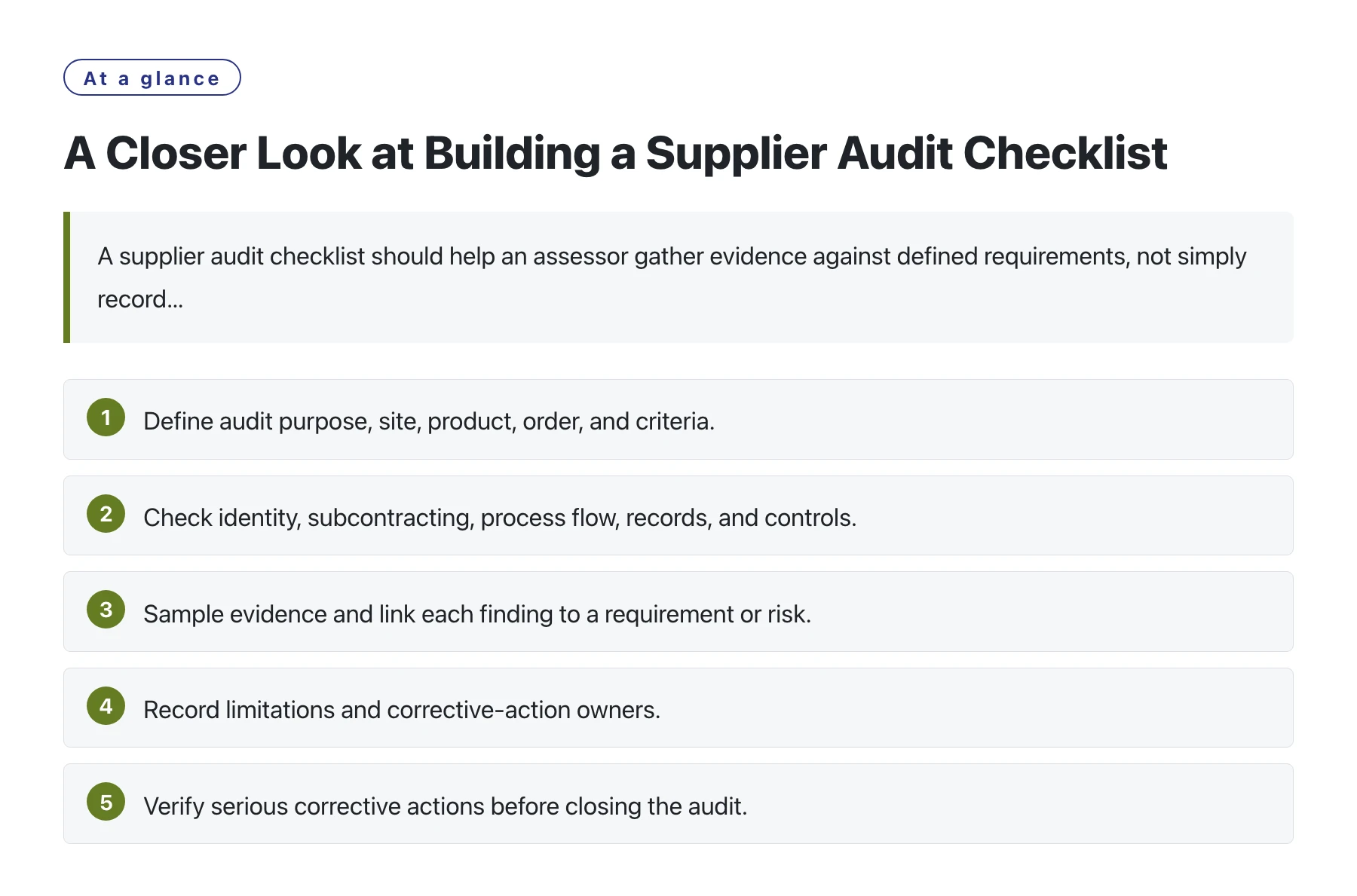
Key takeawaysDefine audit purpose, site, product, order, and criteria. · Check identity, subcontracting, process flow, records, and controls. · Sample evidence and link each finding to a requirement or risk. · Record limitations and corrective-action owners. · Verify serious corrective actions before closing the audit.
A mixed shipment needs one coordinated plan for product compatibility, physical loading, documents, and receipt.
1. Write the audit objective and boundary
Specify whether the checklist supports initial qualification, process review, order readiness, corrective-action verification, or another decision. Identify supplier, factory address, product, order, revision, and audit date. State which activities, sites, and subcontractors are in scope.
List exclusions and required expertise. An audit of management-system processes is different from a finished-goods inspection or regulatory assessment. The checklist should not promise conclusions outside the auditor’s competence or access.
Before the audit, review previous findings and define whether they remain open, recur, or have been verified as effective. Set expected report turnaround and identify who will receive the results. Tell the supplier how records may be requested and what confidentiality rules apply.
2. Verify identity and organizational responsibilities
Record legal entity, production site, address, owner or operator, business relationship, and key contacts. Identify who designs, manufactures, tests, labels, packs, and releases the product. Ask which stages are subcontracted.
Compare the site with quotations, certificates, business documents, invoices, and product records. Mark any mismatch for follow-up. Do not assume the company receiving payment is the factory making the goods.
3. Map processes and critical controls
Build a checklist section for the relevant process route: incoming materials, preparation, production, in-process checks, rework, final inspection, packaging, and dispatch. For each stage, ask what requirement applies, who performs it, how it is recorded, and how failures are handled.
Tailor prompts to product risk. Check equipment, tooling, calibration, training, work instructions, material identification, environmental conditions, and maintenance only where they affect the scope. Generic questions often produce generic answers.
Include a prompt for control of critical equipment and utilities only when they affect the product. Ask how the supplier notices a drift, who may stop a process, and what record proves that the process returned to an approved condition.
4. Review records and traceability
Select records from active and completed orders and tie them to the named site, product, and period. Sample work orders, material lots, inspection results, nonconformances, corrective actions, calibration, and training where relevant. Trace a finished item backward and a material lot forward.
ISO 9001:2026 sets quality management system requirements; a certificate or procedure can inform process review but cannot prove that a particular product or order conforms. Verify actual records and observations against buyer requirements. [1]
5. Include observation and interview prompts
Ask the auditor to observe normal work and compare it with current instructions. Include prompts for operator understanding, defect segregation, revision control, process changes, and supervisor response. Record which area and process were observed.
Interviews can clarify roles and practices but are not substitutes for records. Note inconsistent answers and seek a second source of evidence. Respect confidentiality, safety, translation quality, and site photography rules.
6. Make checklist responses decision-ready
Use fields for requirement, method, evidence, result, finding severity, location, sample, photo or record reference, and auditor note. Allow compliant, noncompliant, observation, not applicable, and not verified outcomes. Avoid forcing a pass where evidence was unavailable.
Define severity and escalation before the audit. A checklist item marked “yes” without source evidence is difficult to review. Link every nonconformance to the requirement or documented risk and keep facts separate from interpretation.
For each checklist section, include a space for evidence reference and sample count. This lets another reviewer understand the basis of the result without repeating the entire assessment or relying on the auditor’s memory.
7. Assign corrective actions and verify closure
For findings, record containment, root-cause request, corrective action, owner, due date, evidence required, and verification method. Keep serious or repeated issues open until an authorized reviewer confirms effective action.
Set follow-up by desk review, remote evidence, or another site visit depending on risk. Keep original finding, supplier response, and verification result together so the history remains visible.
8. Review the checklist after use
After the audit, remove prompts that did not help the decision and add checks that would have exposed a material gap. Compare actual checklist coverage with the audit objective and report limitations. Version-control future revisions.
Use common core questions across suppliers for comparison, then add product- or process-specific prompts. This balances consistency and relevance.
9. Connect audit findings to supplier approval
Summarize capability, evidence strength, major risks, open actions, and conditions for approval. Keep audit status separate from product sample approval, compliance release, and purchase authorization. Name the decision owner for each.
Buyers arranging product quality checks in China can request the checklist, evidence standard, report format, and follow-up scope before the visit.
Sources
Frequently asked questions
What belongs in a supplier audit checklist?
Include scope, identity, processes, records, controls, evidence, findings, limitations, corrective actions, and verification.
Can an audit checklist guarantee supplier quality?
No. It supports a defined review within stated scope; ongoing product and order controls remain necessary.
Should every supplier receive the same checklist?
Use common core questions for comparison, then tailor additional checks to product, process, market, and risk.
When is an audit finding closed?
After required corrective-action evidence is reviewed and the assigned authority verifies closure to the agreed criteria.